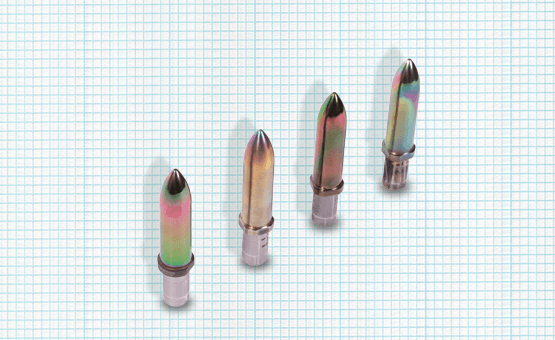

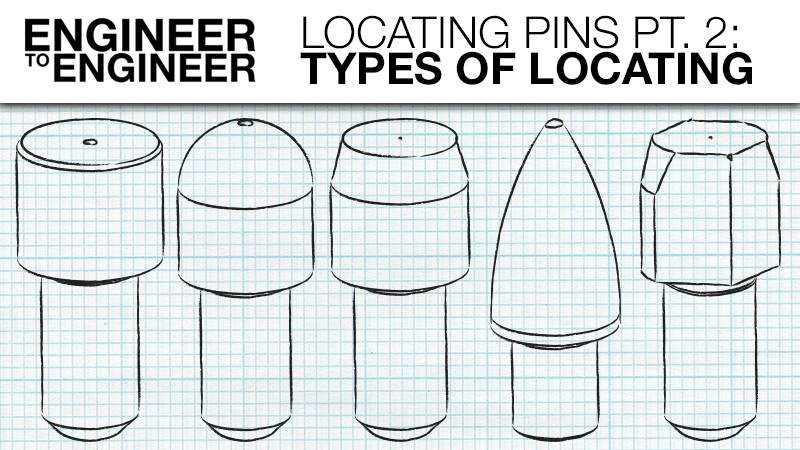
In our second Locating Pins episode in the Engineer to Engineer Series, locating pins are used in workholding fixtures and jigs to secure workpieces during the production of parts. If you are new to workholding concepts, check out our first episode for an introduction to the basics. This episode will take a look at the main types of locating pins, head shapes, and the primary uses for each one.
There are two classifications of locating pins, 2-way and 4-way. A simple method to remember the difference between them is to consider the 3 axes of translational motion, and the 6 corresponding directions or Degrees of Freedom. A 2-way locating pin restricts motion along 1 axis (or 2 degrees of Freedom), like a round pin in a slot. Likewise, a 4-way pin restricts 4 degrees of freedom along 2 axes. A round locating pin located concentrically in a hole is a common application of a 4-way pin, and helps to further secure the piece. In order to sufficiently locate a part, a minimum of one of each type of pin is required to prevent excess motion of the workpiece, and more locating components may be used as needed.
Interested in learning more about types of locating? Watch the video below. Don’t forget to subscribe to our YouTube Channel at http://www.youtube.com/MisumiUSA to be the first to know when we post new content.